
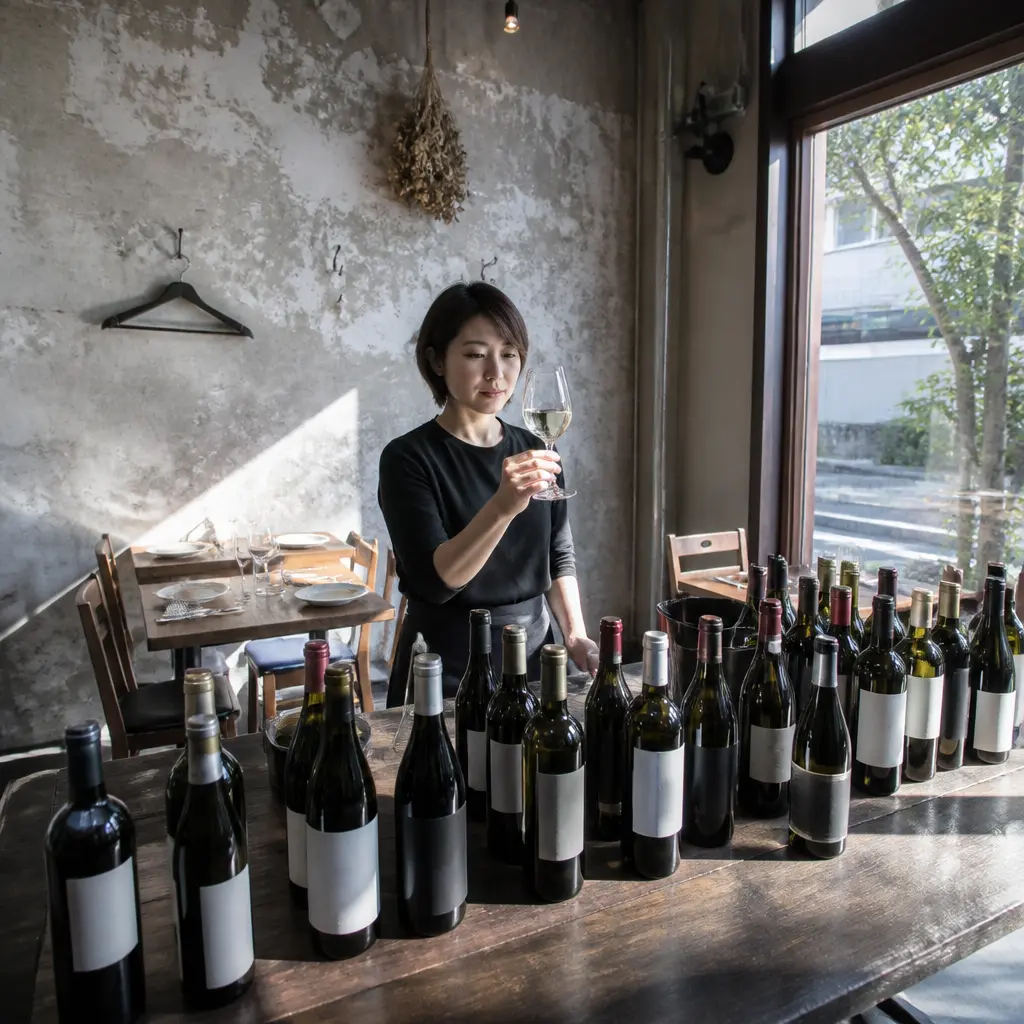
A sommelier’s taste is the trained ability to evaluate, contextualize, and recommend wine according to quality, balance, provenance, food compatibility, and a guest’s preferences. In restaurants, that attribute can matter more than cellar size because a well-curated list converts limited inventory into coherent choices, while a large but poorly edited cellar can overwhelm guests and increase storage, capital, and waste costs. The American Society of Sommeliers and the Association de la Sommellerie Internationale both frame sommellerie as more than tasting: it combines sensory analysis, beverage knowledge, hospitality, purchasing, and service. This makes taste especially valuable in small restaurants, wine bars, destination dining rooms, and emerging regions where selection quality and recommendation accuracy are more meaningful than bottle count.
Curated Taste Defines the Sommelier’s Cellar Advantage
The entity-attribute pairing in this article is “sommelier taste”: the professional’s trained capacity to distinguish meaningful differences among wines and apply those differences to a particular guest, dish, occasion, and price point. The Court of Master Sommeliers describes sommeliers through competencies that include tasting, beverage knowledge, service, and business judgment, while the Wine & Spirit Education Trust treats systematic tasting as a structured process involving appearance, nose, palate, quality assessment, and conclusions. The pairing therefore refers to judgment supported by method, not simply personal preference.
Its principal hyponyms are sensory calibration, list curation, pairing intelligence, cellar stewardship, and guest translation. Sensory calibration asks whether a wine is sound, balanced, age-worthy, and expressive. List curation determines which bottles deserve space. Pairing intelligence connects acidity, tannin, sweetness, texture, and aromatic intensity with food. Cellar stewardship manages condition, rotation, and purchasing risk. Guest translation turns technical knowledge into a recommendation that feels useful rather than intimidating.
Sensory Calibration Rather Than Bottle Recognition
Sensory calibration is the ability to evaluate wine consistently across changing conditions. A strong sommelier can identify structural features such as acidity, tannin, alcohol, body, concentration, and finish, then separate those features from reputation, label design, and price. This matters because blind-tasting research has repeatedly shown that context can influence perception. A widely cited 2008 study by Robin Goldstein, Hilke Plassmann, and colleagues found that stated price affected consumers’ reported enjoyment, even when the wine itself was unchanged.
Calibration does not require the largest cellar. It requires repeated comparison, disciplined note-taking, and exposure to variation within a grape, region, vintage, and production method. A compact list containing several expressions of Chenin Blanc, Nebbiolo, or volcanic-island wine may teach guests more than an undifferentiated inventory of hundreds of labels. The relevant metric is not the number of bottles held but the number of useful distinctions the team can explain and apply.
Curation as the Editorial Function of the Cellar
Curation is the process of selecting wines that express a restaurant’s point of view. It includes producer selection, price architecture, geographic balance, vintage planning, and decisions about what not to buy. A sommelier with taste acts like an editor: the list has a beginning, middle, and purpose, rather than functioning as a warehouse catalogue.
This editorial function is increasingly important as consumers confront a broad and changing market. The International Organisation of Vine and Wine reported that global wine consumption fell to approximately 214 million hectolitres in 2023, the lowest level since 1996, while global production also declined sharply. In a softer market, restaurants face greater pressure to avoid slow-moving purchases and to explain why a bottle deserves a place at the table. A focused list can protect cash flow by emphasizing wines with clear culinary and narrative roles.
Pairing Intelligence Converts Taste into Hospitality
Pairing intelligence is the practical application of sensory knowledge to food and guest context. It does not mean enforcing rigid rules such as “red wine with meat” or “white wine with fish.” Instead, it considers dominant ingredients, cooking methods, sauces, spice, salt, sweetness, acidity, texture, and serving temperature. A high-acid wine may refresh a rich dish; a lightly sweet wine may soften chili heat; a tannic wine may become more harmonious with protein and fat.
The value of this judgment is visible in restaurants with compact beverage programs. A sommelier may use one versatile bottle for several courses, recommend a half-bottle or glass pour, or redirect a guest from an expensive famous label toward a more suitable alternative. The success metric is not the highest check average on every table. It is repeat satisfaction, reduced decision friction, stronger food-and-wine coherence, and a recommendation that guests remember.
Guest Translation Makes Sommelier Taste Commercially Valuable
Taste becomes commercially useful only when it can be communicated. Guest translation is the sommelier’s ability to convert technical attributes into accessible language without diminishing the guest’s autonomy. “Minerality,” “volatile acidity,” “whole-cluster fermentation,” and “ élevage” may be accurate terms, but a guest may need a more direct explanation such as “salty, high-toned, and refreshing” or “silky, savory, and lighter than a typical Cabernet.”
Personalization Beats Prestige
Personalization means matching a recommendation to the guest’s actual preferences, budget, familiarity, and purpose. A collector seeking age-worthy Burgundy, a first-time diner wanting something aromatic, and a group ordering several shared dishes require different forms of expertise. The best recommendation may be obscure, inexpensive, local, or available by the glass rather than prestigious.
This approach also counters the price-bias effect documented in consumer research. If guests are told that a wine costs more, they may anticipate greater pleasure; a sommelier’s responsibility is to provide evidence-based guidance rather than reinforce prestige automatically. A concise explanation of structure and fit can make a $60 bottle feel more successful than a poorly matched $250 bottle.
Storytelling Adds Meaning Without Replacing Quality
Storytelling is the use of place, producer, farming, history, and technique to make a wine intelligible and memorable. It is valuable when it clarifies flavor or purpose. A description of high-elevation vineyards may explain freshness; a reference to old vines may provide context for concentration; an explanation of an indigenous grape may help a guest understand why the wine differs from familiar international varieties.
Storytelling becomes counterproductive when it substitutes romance for balance, cleanliness, or value. The sommelier’s taste must therefore control the narrative. A compelling story can invite the first sip, but the wine’s sensory performance must justify the recommendation.
Cellar Stewardship Turns Taste into Operational Discipline
Cellar stewardship is the management of wine as both a sensory product and a financial asset. It includes storage temperature, humidity, light exposure, stock rotation, inventory accuracy, purchase timing, vintage management, and disposal of compromised bottles. The Institute of Masters of Wine identifies storage and service conditions as important parts of wine quality, while restaurant operators commonly treat beverage inventory as a major working-capital commitment.
Small Cellars Can Be More Responsive
A smaller cellar can provide strategic advantages when its selections are deliberate. It may allow faster rotation, clearer staff training, less tied-up capital, and more frequent adaptation to seasonal menus. A 120-bottle program can be highly distinctive if each wine has a defined role: aperitif, seafood pairing, aromatic white, light red, premium by-the-bottle option, or dessert companion.
The limitation is that a small cellar offers less redundancy. A single sold-out vintage or importer disruption can remove an important category. The remedy is not necessarily expansion; it is intelligent substitution planning. The sommelier should know which wines share structural characteristics, regional identity, or culinary function.
Large Cellars Require Stronger Governance
A large cellar becomes an advantage only when the restaurant can maintain, explain, and sell it. Greater depth can provide older vintages, rare regions, vertical tastings, and options for serious collectors. It also creates risks: dead stock, damaged bottles, inaccurate records, inconsistent service knowledge, and a list so long that guests cannot navigate it.
The distinction is visible in major restaurant wine programs. The World of Fine Wine’s World’s Best Wine Lists awards recognize programs for coherence, originality, depth, and suitability to their setting, not merely for the largest inventory. A deep list with no editorial logic is less useful than a smaller list whose categories, pricing, and descriptions guide decisions efficiently.
Training Multiplies the Value of Taste
Training is the mechanism that distributes a sommelier’s judgment across the service team. Pre-shift tastings, comparative flights, concise pairing notes, and role-played guest conversations help servers understand the reasons behind recommendations. The Wine & Spirit Education Trust reports learners in more than 70 countries and territories, illustrating the international scale of structured beverage education.
A useful training program should measure more than memorization. Managers can track recommendation conversion, guest feedback, by-the-glass waste, bottle rotation, return rates, and the frequency with which staff successfully offer alternatives at different price levels. These measures connect sensory competence to hospitality and financial performance.
Taste Matters Most in Specific Restaurant Contexts
Small Restaurants and Wine Bars
Small restaurants benefit from sommelier taste because their identity depends on selectivity. Limited storage and purchasing power make every bottle consequential. A focused list can emphasize natural-wine literacy, regional discovery, classic appellations, or food-friendly low-alcohol styles without imitating the inventory of a luxury hotel.
Restaurants with Highly Seasonal Menus
Seasonal restaurants need a beverage program that changes with vegetables, seafood, game, preservation, and cooking methods. A sommelier who understands structure can replace heavy winter reds with chilled reds, saline whites, or textured rosés as the menu shifts. Here, adaptability may create more guest value than a permanent list of prestigious labels.
Emerging Wine Regions and Indigenous Grapes
In emerging regions, guests often need interpretation before they need rarity. A sommelier’s taste can identify which producers represent a region clearly, which bottles offer reliable value, and how unfamiliar varieties compare with better-known references. This reduces the perceived risk of exploration and gives smaller producers a route to the table.
Destination Restaurants and Collector-Focused Programs
Large cellars matter more in destination restaurants where guests specifically seek mature vintages, rare formats, and vertical collections. Even there, inventory depth does not replace taste. Collectors expect provenance, condition, accurate vintage information, thoughtful decanting, and a recommendation that respects both the bottle and the meal.
A Practical Scorecard for Measuring Sommelier Taste
Restaurants can evaluate the value of taste through a balanced scorecard rather than bottle count alone. The scorecard should combine sensory, hospitality, and operational indicators.
- Recommendation fit: whether guests describe the wine as suitable for their food, preferences, and budget.
- List coherence: whether each category has a clear purpose and an appropriate range of prices and styles.
- Inventory velocity: whether wines sell within their intended window without excessive discounting or spoilage.
- Staff fluency: whether servers can explain key wines accurately and offer credible alternatives.
- Guest confidence: whether recommendations reduce anxiety and encourage exploration.
- Program identity: whether the list expresses the restaurant’s cuisine, location, values, and level of ambition.
A simple visual for operators would compare cellar size on the horizontal axis with recommendation quality, inventory velocity, and guest satisfaction on the vertical axis. The likely result is not a straight upward line: beyond a certain point, additional bottles produce diminishing returns unless the restaurant also invests in storage, data, training, and service time.
Conclusion: The Sommelier’s Taste Is the Cellar’s Operating System
Sommelier taste matters more than cellar size when the restaurant’s central challenge is selection, explanation, and fit rather than scarcity. Sensory calibration protects quality; curation gives the list a point of view; pairing intelligence connects wine to food; guest translation turns expertise into hospitality; and cellar stewardship protects the financial value of every purchase. Large inventories can create distinction, but only disciplined judgment makes depth usable.
Restaurant owners should therefore audit not only how many bottles they hold but also how clearly those bottles serve guests. Start with a focused tasting calendar, a role-based list, substitution maps, staff education, and metrics for recommendation success. Further reading from the Court of Master Sommeliers, the Wine & Spirit Education Trust, the International Organisation of Vine and Wine, and the Institute of Masters of Wine can help build a beverage program in which taste leads and inventory follows.
Sources: Association de la Sommellerie Internationale, Sommelier Profession and Education Resources, https://www.asi.info/; Court of Master Sommeliers, Americas, Education and Examination Standards, https://www.mastersommeliers.org/; Wine & Spirit Education Trust, Qualifications and Global Education Network, https://www.wsetglobal.com/; Goldstein, Robin, et al., “Do More Expensive Wines Taste Better? Evidence from a Large Sample of Blind Tastings,” Journal of Wine Economics, https://wine-economics.org/jwe/; International Organisation of Vine and Wine, State of the World Vine and Wine Sector in 2023, https://www.oiv.int/; Institute of Masters of Wine, Wine Storage and Service Knowledge, https://www.mastersofwine.org/; The World of Fine Wine, World’s Best Wine Lists, https://www.theworldoffinewine.com/