
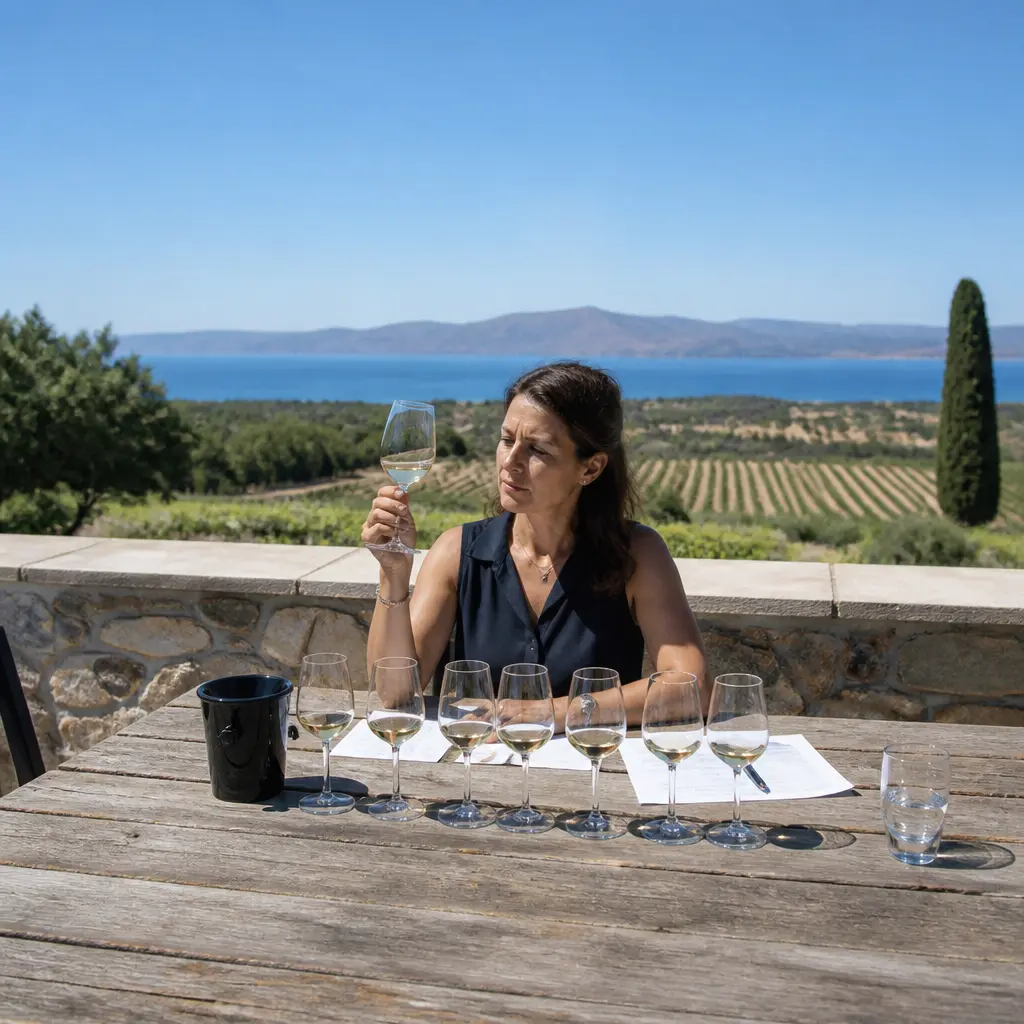
Tactile wines with dynamic mouthfeel are wines whose tannin, acidity, alcohol, phenolic texture, salinity, or carbonation can be felt as clearly as their aromas and flavors, yet remain energetic rather than heavy. The best examples combine grip with lift: Barolo’s firm tannins are animated by Nebbiolo’s acidity, Etna Rosso’s volcanic-site structure is carried by freshness, dry Chenin Blanc can feel waxy and tensile while remaining vivid, and Champagne turns pressure and mousse into movement. This matters because global wine production reached only about 225.8 million hectolitres in 2024, according to the International Organisation of Vine and Wine, making thoughtful evaluation of texture and balance increasingly useful when comparing distinctive wines across regions and styles.
Defining Tactile Wines with Dynamic Mouthfeel
Tactile wine as a sensory attribute
A tactile wine is one whose physical sensations in the mouth are prominent: drying tannin, prickly acidity, creamy viscosity, chalky or grainy grip, saline tension, warmth from alcohol, or the bead of dissolved carbon dioxide. “Dynamic mouthfeel” is not a formal legal category; it describes the way those sensations change during a sip, from entry to mid-palate to finish. The Wine & Spirit Education Trust treats acidity, tannin, alcohol, sweetness, body, and texture as central components of structural analysis, while sensory-science research distinguishes taste from mouthfeel sensations such as astringency and viscosity.
The useful distinction is between texture and weight. A full-bodied wine can feel broad and soft, whereas a tactile wine that still dances has internal contrast: firm but fine tannin, substantial but refreshing acidity, or creamy texture interrupted by a persistent mineral-like or saline impression. In practical terms, the wine does not simply sit on the palate; it pulls, pivots, contracts, expands, and refreshes.
The main tactile hyponyms
Tannic wines create friction or drying through phenolic compounds, particularly tannins that interact with salivary proteins and reduce the sensation of lubrication. Acid-driven wines create salivation and length. Phenolic white wines, including many skin-contact wines, can add grip without the dark-fruit profile associated with red-wine tannin. Sparkling wines add a separate tactile dimension through carbon dioxide, while saline or “stony” descriptions generally refer to a perceived impression of tension and flavor persistence rather than literal dissolved rock.
These categories overlap. A young Barolo is tannic and acid-driven; an Etna Rosso is tannic, savory, and fresh; a dry Vouvray is acid-driven, phenolic, and sometimes waxy; Champagne is acid-driven and carbonated. The following examples show how different combinations can produce movement instead of heaviness.
Tannic Red Wines with Dynamic Mouthfeel
Barolo: Nebbiolo grip carried by acidity
Barolo is a classic example of a tactile wine because Nebbiolo naturally combines high tannin with pronounced acidity and a relatively pale color. Its structure can feel austere in youth, but the acidity prevents the tannin from becoming merely dense. Aromas of rose, red cherry, orange peel, tar, and dried herbs often appear to rise through the structure, creating the impression of vertical movement.
The denomination’s aging requirements reinforce this structural identity: Barolo must be aged for at least 38 months from November 1 of the production year, including 18 months in wood, while Riserva requires at least 62 months. Producers such as G.D. Vajra, Elio Altare, Bartolo Mascarello, and Vietti offer useful comparisons between more immediately expressive and more traditionally austere interpretations. The most compelling bottles do not eliminate tannin; they make the tannin fine-grained enough for acidity, fruit, and perfume to travel through it.
Etna Rosso: volcanic-site tension without heaviness
Etna Rosso, made principally from Nerello Mascalese, often feels tactile through a combination of delicate color, savory phenolics, firm acidity, and dusty or granular tannin. The wine can seem light-bodied at first glance, yet its finish may be notably persistent. This contrast is what makes it dance: the palate receives red fruit and floral notes, then encounters a narrow line of tannin and acidity that keeps the wine moving.
Benanti, Tenuta delle Terre Nere, Passopisciaro, and Graci are real-world reference points for tasting this style. Site elevation, old vines, exposure, winemaking, and vintage conditions all influence texture, so “volcanic” should not be treated as a guarantee of a specific mouthfeel. A useful tasting comparison is to place Etna Rosso beside Barolo: both can be structurally firm, but Etna often feels more transparent and savory, while Barolo tends toward more overt tannic breadth and aromatic power.
Acid-Driven White Wines with Tactile Lift
Dry Chenin Blanc: waxy texture balanced by electric acidity
Dry Chenin Blanc from the Loire demonstrates that tactile intensity does not require red-wine tannin. In Savennières and dry Vouvray, Chenin can combine a waxy, lanolin-like or slightly phenolic texture with high acidity. The texture gives the wine substance, while the acidity creates a tightening and releasing effect across the palate. Notes of quince, apple skin, chamomile, wet stone, and honeycomb can therefore feel layered rather than broad.
Domaine Huet’s Vouvray wines, including Le Mont Sec, and classic Savennières such as Domaine des Baumard or Domaine de la Coulée de Serrant show how the grape can remain energetic at different levels of ripeness and oak influence. Age adds another tactile shift: acidity may seem more integrated, while phenolic bitterness and savory length become more apparent. The result is a white wine with texture that behaves more like a woven fabric than a cushion.
Assyrtiko: saline impression and tensile freshness
Santorini Assyrtiko is another powerful example of a wine that feels firm without becoming sluggish. Its usually high acidity gives the palate a taut, mouthwatering line, while dry conditions and volcanic soils contribute to concentrated fruit and a savory, saline impression. The sensation is often lean, but not thin: the wine can have a substantial mid-palate followed by a sharply persistent finish.
Domaine Sigalas, Gaia Estate’s Thalassitis, and Argyros Estate provide established examples. The word “saline” here is a tasting descriptor, not proof that seawater or literal salt is present in the wine. Food also changes the perception: grilled fish, oysters, lemon, and olive oil can make the wine’s acidity and savory finish seem broader and more fluid, whereas an overly salty dish may exaggerate hardness.
Carbonation and Phenolics as Tactile Drivers
Champagne: mousse as movement
Champagne creates tactile motion through dissolved carbon dioxide, acidity, and lees-derived creaminess. The Comité Champagne states that pressure in a finished bottle is commonly around 5 to 6 bars at 20 degrees Celsius. That pressure is not merely a technical curiosity: it produces the fine bubbles and persistent mousse that stimulate the palate, lift aromas, and interrupt the wine’s texture with a sequence of small sensations.
Blanc de Blancs Champagne, particularly from producers such as Pierre Peters, Agrapart & Fils, or Salon, often shows the clearest combination of chalky or saline impression, citrus acidity, and fine mousse. Grower Champagne from a site-specific producer may feel more vinous and textured, while a younger non-vintage bottling can emphasize freshness and bead. In both cases, “dance” comes from the interaction between bubbles and acid, not from effervescence alone.
Skin-contact Ribolla Gialla: phenolic grip with freshness
Skin-contact white wines demonstrate a different type of tactile structure. Extended contact with grape skins can extract phenolic compounds, producing bitterness, tea-like grip, and a drying finish. When the fruit retains sufficient acidity, the wine can remain mobile rather than becoming coarse. Gravner’s Ribolla Gialla from Friuli-Venezia Giulia is a landmark example, with extended maceration and aging that can produce a wine closer in structural behavior to a light red than to a conventional crisp white.
The key variable is not simply whether a wine is orange-colored. Skin-contact duration, vessel, grape health, sulfur management, oxidation, and acidity all affect the result. A well-balanced example has phenolic tension that frames the fruit and savory flavors; an unbalanced one may feel bitter, hot, or excessively drying. Tasting a skin-contact Ribolla beside dry Chenin Blanc makes the distinction clear: both may be textural, but Chenin’s movement is usually driven more by acidity and intrinsic grape texture, while Ribolla adds deliberate phenolic friction.
How to Recognize a Tactile Wine That Still Dances
Assess entry, mid-palate, and finish
Taste the wine in three stages. At entry, note whether acidity, tannin, alcohol, sweetness, or carbonation arrives first. In the mid-palate, ask whether the wine gains definition or merely becomes heavier. On the finish, observe whether tannin dries evenly, acidity keeps salivation active, bubbles remain fine, or bitterness adds useful length. A dynamic wine often changes at least twice during the sip.
A practical tasting chart would place perceived grip on the horizontal axis and freshness on the vertical axis. Barolo and young skin-contact Ribolla Gialla would sit toward the high-grip side; Champagne Blanc de Blancs and Assyrtiko would sit toward the high-freshness side; the most “dancing” examples would occupy the upper-right area, where substantial texture meets strong lift. The chart is conceptual rather than laboratory measurement, but it helps separate tactile complexity from simple body or alcohol.
Pair texture with food texture
Food provides a useful validation of tactile balance. Tannin becomes more supple with protein and fat, which is why Barolo can work with braised beef, mushrooms, and aged cheese. High-acid Chenin Blanc and Assyrtiko can cut through fried or oily foods. Champagne’s mousse can refresh the palate after creamy or salty dishes. Skin-contact whites often suit roasted vegetables, poultry, and lightly spiced foods when their bitterness is moderate.
Serving conditions also matter. Excessive warmth amplifies alcohol and can flatten freshness; excessive chill can exaggerate tannin and suppress aroma. Decanting may help a young Barolo or Etna Rosso integrate, while a delicate Champagne usually benefits more from an appropriately shaped glass and gradual warming. These choices reveal whether structure is integrated or merely forceful.
Conclusion: Tactile Wines Need Contrast, Not Softness
Real tactile wines that still dance on the palate are defined by contrast: Barolo joins tannic grip to acidity; Etna Rosso combines savory phenolics with transparency; dry Chenin Blanc turns waxy texture into lift; Assyrtiko uses tensile acidity and saline impression; Champagne converts pressure into rhythmic mousse; and skin-contact Ribolla Gialla adds phenolic structure while retaining freshness. The shared principle is balance in motion, not the absence of structure.
For further exploration, taste these wines side by side in flights organized by tactile driver: tannin, acidity, carbonation, and phenolic contact. Record the sensation at entry, mid-palate, and finish rather than relying only on flavor descriptors. That approach makes texture more precise, clarifies why certain wines feel energetic, and offers a more complete way to understand quality across regions, grapes, and winemaking traditions.
Sources: International Organisation of Vine and Wine, State of the World Vine and Wine Sector in 2024, https://www.oiv.int/what-we-do/corporate-publications/state-of-the-world-vine-and-wine-sector-in-2024; Wine & Spirit Education Trust, Systematic Approach to Tasting Wine, https://www.wsetglobal.com/knowledge-centre/wset-systematic-approach-to-tasting-sat/; Comité Champagne, Champagne and Pressure, https://www.champagne.fr/en/about-champagne/how-champagne-is-made/the-bottle; Barolo Barbaresco Alba Langhe and Dogliani Protection Consortium, Barolo Denomination Regulations and Aging Requirements, https://www.langhevini.it/en/; Frontiers in Nutrition, Astringency: Mechanisms and Perception, https://www.frontiersin.org/journals/nutrition; Consorzio di Tutela Vini Etna DOC, Etna DOC Regulations and Territory, https://www.consorzioetnadoc.com/; Comité Interprofessionnel des Vins de Loire, Loire Wine Appellations, https://www.vinsvaldeloire.fr/; Santorini Wine Association, Assyrtiko and Santorini Wine, https://santoriniwinemakers.com/; Gravner, Ribolla Gialla and Winemaking, https://www.gravner.it/