
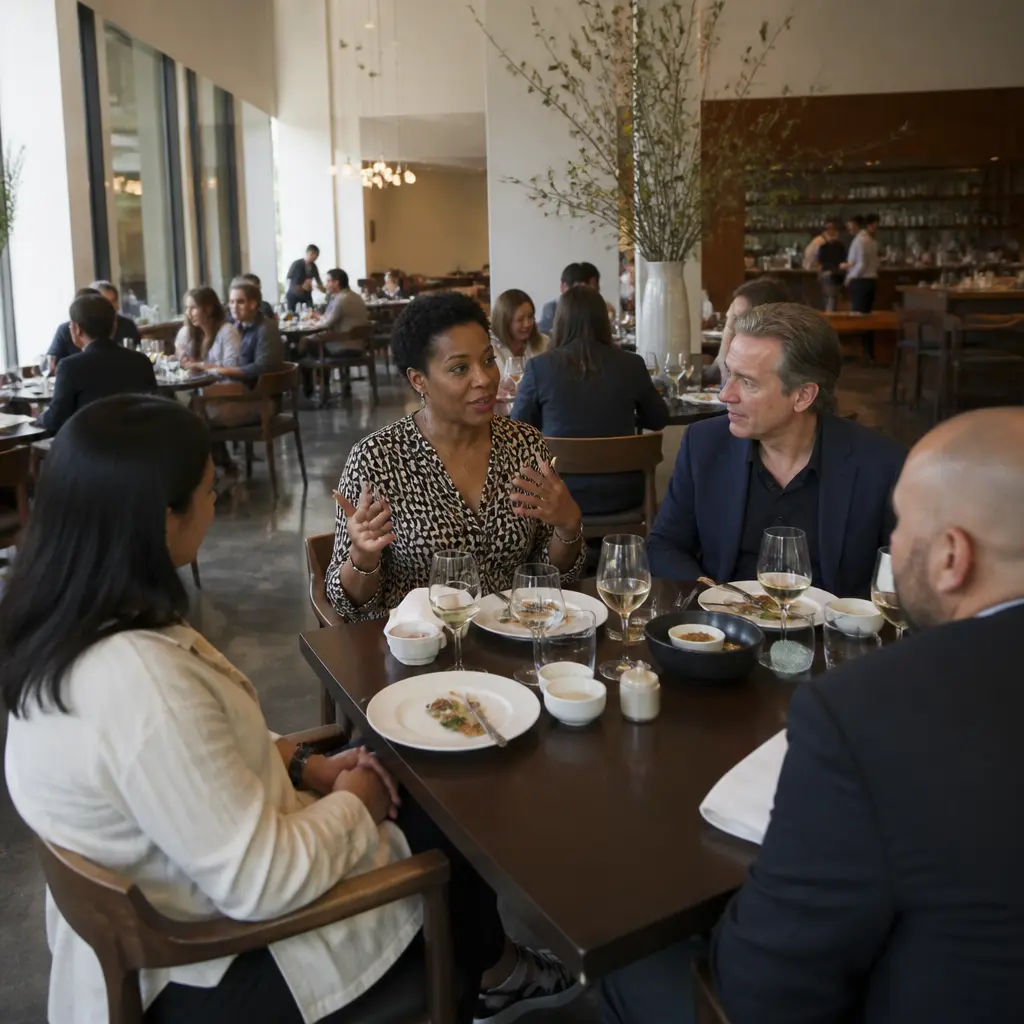
Restaurants with memorable dining experiences turn a meal into a story: a destination worth traveling for, a tasting menu that changes how guests understand an ingredient, or a room whose hospitality makes strangers feel like regulars. This article defines that category, explains its main forms, and examines examples including Disfrutar, Central, Osteria Francescana, Eleven Madison Park, and other globally recognized restaurants. Their relevance extends beyond luxury dining: the National Restaurant Association projected approximately $1 trillion in U.S. restaurant and foodservice sales for 2024, showing how competition for attention and loyalty makes distinctive experiences increasingly valuable.
Restaurants—Memorable Dining Experiences as a Distinct Attribute
“Memorable dining experience” is not an official Michelin or government classification. It is a practical attribute describing a restaurant whose food, setting, service, cultural meaning, or sense of occasion creates a durable memory and a story guests want to retell. Experience-economy scholars B. Joseph Pine II and James H. Gilmore define an experience as an offering in which a company “uses services as the stage and goods as the props” to engage customers in a memorable event. Applied to restaurants, the definition includes the meal itself but also the sequence, setting, people, expectations, and emotional aftereffect.
The strongest examples usually combine several characteristics: a clear point of view, technical consistency, a distinctive sense of place, meaningful hospitality, and enough surprise to reward attention. Michelin’s three-star language captures one part of this distinction: one star means high-quality cooking, two stars mean cooking worth a detour, and three stars mean exceptional cuisine worth a special journey. A restaurant can therefore be memorable without holding three stars, but the Michelin framework illustrates why culinary quality and destination value often reinforce one another.
Destination Restaurants: Meals Worth the Journey
A destination restaurant is a place whose reputation motivates guests to travel specifically for the meal. Its appeal may come from exceptional technique, a remote setting, a famous chef, or a combination of food and local identity. Central in Lima is a clear example: Virgilio Martínez and Pía León organize the menu around Peru’s ecosystems and elevations, turning geography into a progression guests can taste. The restaurant ranked first in The World’s 50 Best Restaurants 2023 list and remains part of the list’s “Best of the Best” group after its top placement.
Disfrutar in Barcelona demonstrates a different form of destination appeal. Founded by chefs Eduard Xatruch, Oriol Castro, and Mateu Casañas, it pairs highly technical dishes with playful manipulation of texture, temperature, and expectation. The World’s 50 Best Restaurants named Disfrutar the world’s number-one restaurant in 2024. Its significance is not simply the ranking; it is the way the meal gives diners recognizable moments to describe afterward, such as a familiar flavor presented in an unfamiliar physical form.
Tasting-Menu Laboratories: Culinary Ideas as Story Structure
A tasting-menu laboratory uses a sequence of small courses to develop an argument about ingredients, technique, or place. Unlike an à la carte meal, the format gives the kitchen control over pacing and progression. Courses can function like chapters: an opening establishes the restaurant’s vocabulary, middle courses build complexity, and a final sequence supplies contrast or emotional closure.
Osteria Francescana in Modena, led by Massimo Bottura, illustrates how narrative can emerge from reinterpretation. Dishes such as “Oops! I Dropped the Lemon Tart” use imperfection and humor to challenge conventional ideas of elegance while remaining technically controlled. The restaurant has held three Michelin stars and twice topped The World’s 50 Best Restaurants list, in 2016 and 2018. The case shows that memorable fine dining is not necessarily solemn; wit can be as important as rarity.
Noma in Copenhagen built another influential model around seasonal research, fermentation, and changing menus. Its regular Copenhagen restaurant announced that it would end normal service after the 2025 season and evolve toward a broader culinary project. That transition is itself evidence of the laboratory model: the restaurant’s value rests not only on a fixed menu but also on experimentation, discovery, and a sense that guests are witnessing a temporary stage in an ongoing body of work.
Culture-Led Restaurants: Local Identity on the Plate
A culture-led restaurant makes local history, agriculture, craft, or community central to the dining experience. It does more than serve regional ingredients; it explains why those ingredients matter. This approach can protect culinary traditions, increase interest in local producers, and give visitors a more meaningful alternative to standardized luxury.
Central’s altitude-based menu is one example, while restaurants such as Maido in Lima connect Japanese techniques with Peruvian ingredients and sensibilities. Asador Etxebarri in Atxondo, Spain, takes a more elemental route, using wood fire and exceptional produce as its signature language. It ranked second on The World’s 50 Best Restaurants 2024 list. These restaurants demonstrate that a strong sense of place does not require rustic presentation; regional identity can be expressed through research, precision, restraint, or theatricality.
Restaurants—Memorable Hospitality and the Complete Guest Journey
Food creates the foundation, but memorable restaurants manage the entire guest journey: reservation, arrival, seating, explanation, pacing, payment, and follow-up. The Cornell School of Hotel Administration has consistently treated service encounters as central to hospitality value because customers judge not only what they receive but also how the organization makes them feel during the exchange.
Service-Led Restaurants: Recognition, Rhythm, and Trust
Service-led restaurants make attentiveness feel personal rather than procedural. Staff may remember dietary needs, explain a technique without condescension, adjust pacing to the table, or recognize when a guest wants discovery rather than interruption. The best service disappears into the experience while still making the diner feel carefully considered.
This attribute is especially important in restaurants serving elaborate tasting menus, where guests may spend several hours at the table. A technically brilliant menu can become exhausting if explanations are repetitive, courses arrive too quickly, or the room feels indifferent. Conversely, thoughtful pacing can make a simpler meal feel generous. Service is therefore not decoration around cuisine; it is part of the restaurant’s product.
Theatrical and Immersive Restaurants: Designing the Unexpected
Theatrical restaurants deliberately choreograph surprise through presentation, sound, architecture, tableside preparation, or interaction. The objective is not spectacle for its own sake. Effective theater gives a dish context and helps guests remember a sequence of events rather than a list of ingredients.
Eleven Madison Park in New York offers a notable case study. Under Daniel Humm, the restaurant shifted to a fully plant-based menu in 2021 while retaining its three-Michelin-star status. That decision made the restaurant’s identity part of the conversation: guests were not only evaluating flavor but also considering luxury, sustainability, and what a celebratory meal can be. The example illustrates both the power and risk of memorable positioning: a clear idea attracts attention, but it also invites more demanding scrutiny.
Restaurants—Why Memorable Meals Become Long-Term Stories
Memorable meals tend to contain a combination of novelty, emotional relevance, and social usefulness. Novelty supplies the unexpected event; emotional relevance connects the experience to a birthday, journey, relationship, or personal aspiration; and social usefulness gives guests a story they can share. A rare ingredient alone may be forgotten, while an ordinary ingredient connected to a vivid setting or human moment can remain meaningful for decades.
The Memory Formula: Contrast, Meaning, and Retellability
Contrast makes a meal legible. Examples include a humble ingredient presented with luxury-level precision, a refined dish served in an informal room, or a familiar flavor transformed through modern technique. Meaning links the contrast to a larger idea such as regional ecology, family history, sustainability, or culinary heritage. Retellability follows when the guest can summarize the experience in a sentence without reducing it to “the food was good.”
- A distinctive signature dish gives the meal a memorable anchor.
- A coherent menu creates progression rather than disconnected courses.
- A sense of place makes the experience difficult to copy elsewhere.
- Human hospitality turns precision into warmth.
- A surprising detail creates the moment guests quote later.
Recognition Metrics: Stars, Rankings, and Their Limits
Awards provide useful signals but cannot fully measure memory. Michelin stars primarily evaluate cooking, ingredients, technique, harmony, personality, and consistency. The World’s 50 Best Restaurants uses a large international voting academy and captures broader perceptions of influence, excitement, and contemporary relevance. James Beard Awards focus on the American restaurant and chef landscape. These systems help diners discover candidates, but the absence of an award does not mean a restaurant lacks meaning, and a high ranking cannot guarantee personal connection.
A useful comparison is to treat awards as reputation metrics and guest stories as experience metrics. A restaurant may achieve global recognition through technical excellence, while a neighborhood institution may create stronger memories through familiarity, continuity, and community. The most durable reputations often combine both: an identifiable culinary point of view and a guest experience that feels human.
Restaurants—How to Choose a Meal You Will Remember
Travelers choosing among celebrated restaurants should begin with the kind of memory they want, not merely the highest ranking. A destination meal may suit someone seeking a once-in-a-lifetime journey; a culture-led restaurant may better serve a traveler interested in local history; and a service-led neighborhood restaurant may be ideal for an intimate celebration.
- Read the restaurant’s own description to identify its central idea, such as ecology, fire, fermentation, heritage, or plant-based cooking.
- Study recent menus and guest reports for evidence of consistency, pacing, accessibility, and dietary accommodation.
- Reserve enough time for the format; a long tasting menu should not be scheduled between flights or meetings.
- Consider the room, neighborhood, and arrival experience as part of the meal rather than separate logistics.
- Choose a restaurant whose values genuinely interest you, since curiosity increases attention and strengthens memory.
For readers planning further research, a useful comparison chart would place restaurants on four axes: culinary innovation, sense of place, hospitality, and theatricality. Such a chart should be treated as a guide rather than a definitive scorecard. Personal taste, budget, accessibility, and occasion remain decisive.
Conclusion: Restaurants That Become Part of a Person’s Story
Restaurants that guests talk about for years usually deliver more than excellent dishes. Destination restaurants make travel feel justified; tasting-menu laboratories turn cuisine into a developing narrative; culture-led restaurants give local identity a place at the table; and service-led or theatrical restaurants make the guest feel present inside a carefully designed event. Examples such as Central, Disfrutar, Osteria Francescana, Noma, Asador Etxebarri, and Eleven Madison Park show that memorability can come from geography, humor, research, fire, hospitality, or a bold philosophical change.
The broader lesson is that restaurant value increasingly includes meaning, not just consumption. As the global dining market becomes more competitive and diners share experiences instantly, a restaurant’s strongest asset may be the story guests carry away. Before making a reservation, look beyond rankings and ask what the restaurant is trying to express, how it treats people, and whether that idea connects with the occasion you want to remember.
Sources: National Restaurant Association, 2024 State of the Restaurant Industry Report, https://restaurant.org/research-and-media/research/research-reports/2024-state-of-the-restaurant-industry-report/; Pine, B. Joseph II, and James H. Gilmore, The Experience Economy: Competing for Customer Time, Attention, and Money, Harvard Business Review Press, https://store.hbr.org/product/the-experience-economy-competing-for-customer-time-attention-and-money/10094; Michelin Guide, The MICHELIN Guide to the Stars, https://guide.michelin.com/en/article/features/the-michelin-guide-to-the-stars; The World’s 50 Best Restaurants, The World’s 50 Best Restaurants 2024, https://www.theworlds50best.com/list/1-50; The World’s 50 Best Restaurants, The World’s 50 Best Restaurants 2023, https://www.theworlds50best.com/list/1-50; Noma, Noma’s Future, https://noma.dk/; Eleven Madison Park, Plant-Based Menu, https://www.elevenmadisonpark.com/; Cornell University School of Hotel Administration, The Center for Hospitality Research, https://sha.cornell.edu/centers-institutes/chr/; James Beard Foundation, Awards, https://www.jamesbeard.org/awards.