
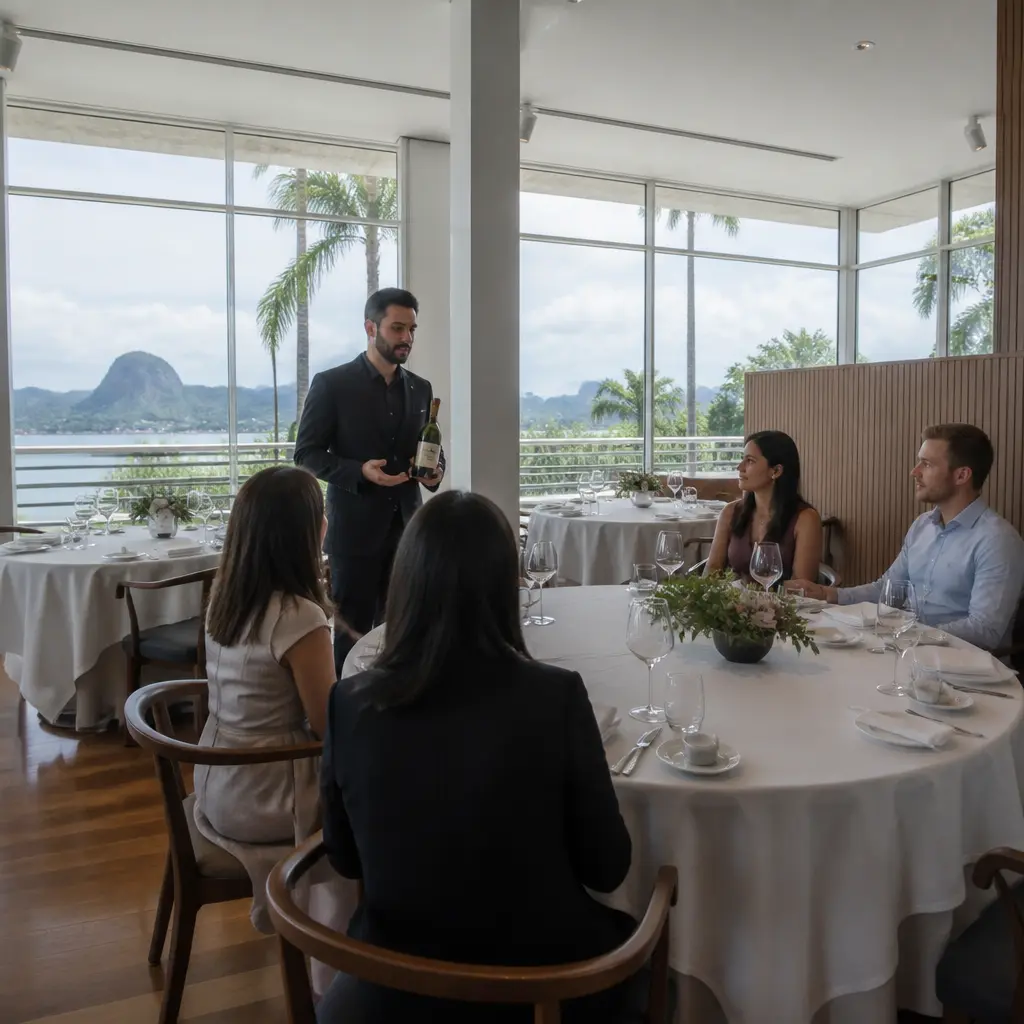
Fine dining is the deliberate integration of exceptional food, service, setting, and hospitality into a memorable guest experience. Its emotional resonance—the capacity of a meal to create feelings, memories, identification, and personal meaning—elevates cuisine far beyond technical execution. Culinary technique remains essential, but research on multisensory perception, experiential consumption, and hospitality shows that diners judge experiences through a combination of flavor, atmosphere, narrative, human connection, and perceived value. This matters in a global restaurant industry that the National Restaurant Association estimated would exceed $1 trillion in U.S. sales in 2024, because emotional connection can distinguish one technically competent restaurant from another and encourage loyalty, recommendations, and return visits.
Emotional Resonance—Fine Dining as an Experiential Attribute
Emotional resonance in fine dining can be defined as the lasting psychological response produced when a meal connects sensory pleasure with personal memory, cultural meaning, anticipation, surprise, or human recognition. The concept is consistent with the experience economy described by B. Joseph Pine II and James H. Gilmore, who distinguish experiences from ordinary goods and services because experiences engage customers in a memorable event. In this context, fine dining is not simply the delivery of prepared food; it is the orchestration of an encounter that guests interpret and remember.
The attribute includes several related forms, or hyponyms: sensory resonance, narrative resonance, relational resonance, cultural resonance, and commemorative resonance. A dish may create sensory resonance through aroma and texture, narrative resonance through an explanation of its origin, relational resonance through attentive service, cultural resonance through a respectful connection to place, and commemorative resonance by becoming associated with an anniversary or milestone.
Sensory resonance: when technique becomes perception
Sensory resonance occurs when culinary technique produces an emotionally meaningful perception rather than merely a technically correct result. Temperature, acidity, contrast, aroma, sound, color, and texture influence how diners interpret flavor and satisfaction. The food may be precisely cooked, but its effect depends on the complete sensory environment in which it is encountered.
Research by Charles Spence and colleagues on multisensory flavor perception demonstrates that taste is shaped by information received through multiple senses. Sound, visual presentation, tableware, and context can alter perceived flavor and quality. A carefully plated course therefore communicates before the first bite. The contrast between a brittle garnish and a soft center, or between a fragrant broth and a restrained garnish, can transform technical control into anticipation, pleasure, and surprise.
A well-known experiment by Adrian North, David Hargreaves, and Jennifer McKendrick found that background music influenced diners’ wine selections: French music increased the selection of French wine, while German music increased the selection of German wine. The finding illustrates a central principle of emotional resonance: environmental cues do not merely decorate the meal; they frame its meaning.
Narrative resonance: when ingredients carry meaning
Narrative resonance is the emotional impact created when a restaurant gives diners a coherent reason to care about an ingredient, dish, producer, or cooking tradition. A narrative can explain a chef’s relationship to a region, a farmer’s cultivation methods, a family recipe, or the history behind a preparation. Its purpose is not to turn every course into a lecture. Rather, it gives sensory details a human and cultural frame.
The strongest narratives are specific, proportionate, and verifiable. A server who explains that a vegetable comes from a nearby farm, describes why it was harvested at a particular stage, and connects the preparation to the menu’s seasonal theme helps the guest understand the dish as an intentional act. This approach also reflects the principles of authenticity discussed in hospitality and consumer research: diners respond more strongly when a story appears integrated with actual sourcing, technique, and place rather than added as decorative marketing.
Relational resonance: when service becomes recognition
Relational resonance is the feeling that a guest is seen, understood, and cared for by the people delivering the experience. It includes warmth, timing, discretion, informed guidance, and the ability to respond intelligently to a diner’s needs. Fine-dining service succeeds emotionally when it is attentive without being intrusive and confident without becoming theatrical.
This dimension explains why hospitality cannot be reduced to a sequence of operational tasks. The same menu can feel cold in an impersonal room and deeply moving when staff recognize an important occasion, explain unfamiliar ingredients clearly, or adapt gracefully to a guest’s preferences. The Cornell School of Hotel Administration has consistently treated service encounters and perceived value as central components of restaurant satisfaction. Technical excellence may win admiration, but thoughtful recognition often determines whether admiration becomes loyalty.
Memory—Fine Dining as a Durable Emotional Attribute
Memory is the bridge between an excellent meal and a meaningful one. Diners rarely remember every component of a tasting menu with equal precision. They are more likely to recall a dramatic reveal, an unexpected act of kindness, a distinctive aroma, a view, a conversation, or the feeling associated with a celebration. Emotional intensity and narrative coherence help selected moments remain accessible after technical details have faded.
Commemorative resonance: meals attached to life events
Commemorative resonance occurs when a restaurant becomes part of a significant personal event, such as a birthday, proposal, graduation, reunion, or professional achievement. The restaurant does not create the meaning of the event by itself; it provides a setting in which that meaning can be expressed. Small, well-judged gestures—a handwritten note, a carefully timed dessert, or a discreet acknowledgment—can make the experience feel singular without undermining its sophistication.
This form of resonance is commercially important because memory supports word-of-mouth behavior. A guest who recalls how a restaurant made an important evening feel is more likely to recommend it in emotional rather than purely functional language. “The fish was precisely cooked” is positive, but “they understood exactly how to make the evening special” communicates a stronger reason to return.
Cultural resonance: place, identity, and responsible interpretation
Cultural resonance connects a meal to a community, landscape, tradition, or identity. It may emerge through regional ingredients, inherited techniques, local ceramics, language, music, or an honest account of culinary exchange. The most responsible expression avoids reducing culture to an aesthetic theme. It recognizes sources, credits communities, and presents traditions with context.
Restaurants that work with local producers can make sustainability tangible by showing diners how seasonality, biodiversity, and supply relationships affect the menu. The United Nations Environment Programme has identified food systems as a major contributor to environmental pressures, while the Food and Agriculture Organization emphasizes the importance of sustainable, resilient food systems. Emotional connection can make these complex issues understandable, provided that environmental or ethical claims are specific rather than vague.
Hospitality—Fine Dining as an Integrated Emotional Attribute
Hospitality is the integration point where food, space, service, and story become one experience. A restaurant may possess outstanding technique but fail to create resonance if the pacing is chaotic, the room is uncomfortable, or the service contradicts the menu’s values. Conversely, emotional warmth cannot compensate indefinitely for poorly prepared food. The goal is alignment: every operational choice should reinforce the intended feeling.
Atmosphere and pacing
Atmosphere includes lighting, acoustics, seating, temperature, table design, scent, spatial arrangement, and visual rhythm. Pacing includes the interval between courses, the timing of explanations, the management of pauses, and the duration of the overall meal. Together they regulate attention and anticipation. A quiet pause can create suspense; an overlong delay can create irritation. Emotional resonance therefore depends on choreography as much as decoration.
A useful way to present this relationship is through a simple experience map: anticipation leads to arrival, orientation, discovery, climax, reflection, and farewell. A restaurant can plot guest touchpoints across these stages and identify where emotion should intensify or relax. A textual version of this map would show that a signature course may provide the culinary climax, while a gracious farewell extends the memory beyond the final bite.
Personalization without performance
Personalization means adapting the experience to relevant guest information while preserving dignity and consistency. It can involve remembering allergies, adjusting the pace for a theater reservation, offering an appropriate nonalcoholic pairing, or recognizing returning guests without excessive familiarity. The best personalization is often invisible: it removes friction rather than announcing itself.
This principle is especially important as restaurants collect more reservation and preference data. Information can improve service, but careless use can feel intrusive. Emotional resonance depends on trust, so staff should use guest information only when it clearly improves comfort, accessibility, or relevance.
Technique—Fine Dining as the Foundation of Emotional Resonance
Technique remains the foundation because emotional meaning cannot fully overcome inconsistency, unsafe food, poor temperature control, or unbalanced flavor. Precision gives chefs the freedom to create contrast, surprise, and reliability. The distinction is not between technique and emotion; it is between technique as an endpoint and technique as a means of communication.
A technically accomplished dish communicates care through repeatable execution. When that execution is joined to a credible story, a welcoming service culture, and a coherent environment, the diner experiences more than competence. The diner experiences intention. That perception is the defining value of emotional resonance.
Conclusion—Fine Dining’s Emotional Resonance as Competitive Advantage
Fine dining becomes more powerful when emotional resonance connects technique to memory, narrative, culture, and human recognition. Sensory resonance makes precision perceptible; narrative resonance gives ingredients meaning; relational resonance turns service into care; commemorative resonance attaches the restaurant to important life events; and cultural resonance links the meal to place and identity. Together, these attributes explain why two restaurants with comparable culinary skill can produce very different levels of loyalty and advocacy.
For chefs, restaurateurs, and hospitality teams, the practical call to action is to design the entire guest journey rather than focusing exclusively on the plate. Map the emotional stages of the meal, train staff in responsive hospitality, verify sourcing stories, measure guest feedback beyond satisfaction scores, and protect the authenticity of every interaction. Further reading in experience design, multisensory perception, service management, and sustainable food systems can help restaurants build experiences that guests do not merely evaluate, but remember.
Sources: National Restaurant Association, 2024 State of the Restaurant Industry Report, https://restaurant.org/research-and-media/research/research-reports/state-of-the-restaurant-industry/; Pine, B. Joseph II and James H. Gilmore, Welcome to the Experience Economy, Harvard Business Review, https://hbr.org/1998/07/welcome-to-the-experience-economy; Spence, Charles et al., Multisensory Flavor Perception and the Design of Food Experiences, https://doi.org/10.1016/j.foodqual.2014.04.001; North, Adrian C., David J. Hargreaves, and Jennifer McKendrick, The Influence of In-Store Music on Wine Selections, Journal of Applied Psychology, https://doi.org/10.1037/0021-9010.84.2.271; Cornell School of Hotel Administration, Cornell University, https://sha.cornell.edu/; Food and Agriculture Organization of the United Nations, Sustainable Food Systems, https://www.fao.org/3/ca2079en/CA2079EN.pdf; United Nations Environment Programme, Sustainable Food Systems, https://www.unep.org/explore-topics/resource-efficiency/what-we-do/sustainable-food-systems.