
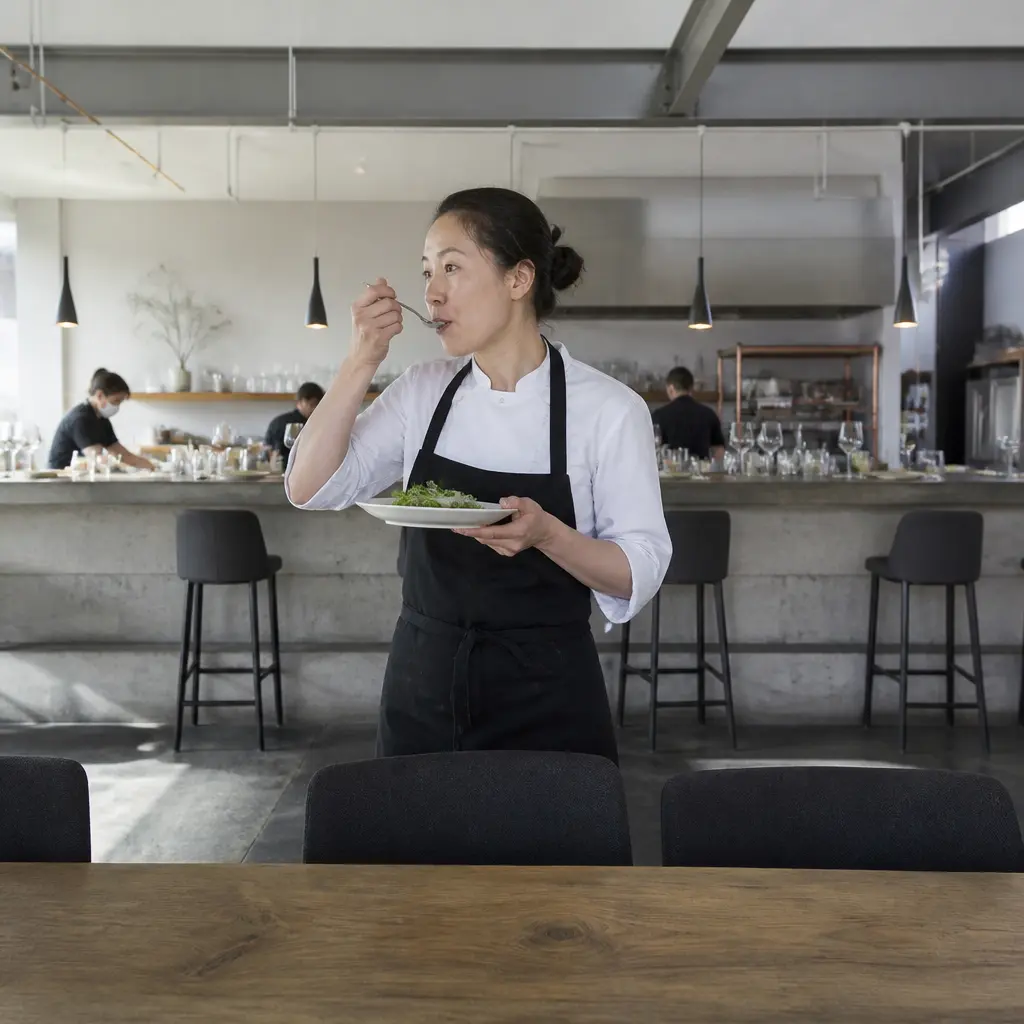
A restaurant with a lingering finish is one whose final bite continues to shape perception after the food has left the mouth. This effect comes from a designed combination of aroma, taste, texture, temperature, fat, spice, and acidity rather than from intensity alone. Sensory research shows that volatile aromas can persist through retronasal breathing, capsaicin can continue activating heat receptors, and fats can slow the release of flavor compounds. In a restaurant economy projected by the National Restaurant Association to exceed $1 trillion in 2024 sales, that final sensory impression matters: it can influence satisfaction, memory, reviews, repeat visits, and the decision to order dessert, coffee, or another drink.
Create a Lingering Finish in Restaurants
The entity-attribute pairing “restaurants with a lingering finish” describes restaurants that deliberately produce a durable post-bite sensory impression. Food scientist Peter K. H. G. describes flavor as a multisensory experience involving taste, smell, touch, temperature, and chemical sensations; therefore, a lingering finish is not simply a dish that tastes powerful. It is a controlled persistence of one or more sensations after swallowing.
The strongest examples balance persistence with relief. Aged cheese may leave savory, nutty, and salty notes; dark chocolate may leave bitterness and roasted aroma; chili may create a slowly fading burn; and a citrus dessert may finish with acidity that cleanses the palate while its aromatic oils remain. These are hyponyms of the broader category: aromatic finishes, umami finishes, bitter finishes, spicy finishes, fatty finishes, acidic finishes, and textural finishes.
Aromatic Finish: Flavor That Returns Through the Nose
An aromatic finish is the continued perception of volatile flavor compounds after chewing or swallowing. It is strongly connected to retronasal olfaction, in which aromas travel from the mouth to the nasal cavity during exhalation. This explains why a diner can remember the smell of roasted coffee, grilled meat, citrus peel, herbs, or wine even after the basic tastes have faded.
Restaurants create aromatic persistence through roasting, charring, fermentation, smoking, and the use of concentrated oils. Coffee offers a clear case: roasting creates hundreds of volatile compounds, while crema and surface oils help carry aroma. In a tasting menu, a final garnish of lemon zest, mint oil, toasted spice, or browned butter can extend the dish’s identity without adding much volume.
A useful way to visualize this effect is a flavor-decay chart: the initial bite produces a sharp rise in taste and aroma, while volatile compounds form a slower declining curve. Dishes with a lingering finish do not necessarily reach the highest initial peak; they maintain a more recognizable curve after the peak has passed.
Umami and Savory Persistence: The Finish of Broths, Cheese, and Fermentation
An umami finish is a prolonged savory impression associated with glutamate and related compounds. The fifth basic taste is commonly linked to foods such as mushrooms, tomatoes, seaweed, aged cheese, meat stocks, soy sauce, and fermented products. The International Glutamate Technical Committee explains that umami can enhance fullness and continuity in a dish, especially when it is combined with aromas and salt.
Restaurant kitchens extend umami through reduction, aging, fermentation, and concentration. A long-simmered broth, parmesan foam, miso glaze, or mushroom jus can remain perceptible because multiple flavor compounds overlap rather than disappearing at once. This is why a carefully reduced sauce may be remembered more vividly than a larger portion of a lightly seasoned ingredient.
The relevant design principle is layering. Glutamate supplies savory depth, nucleotides in meat or seafood can intensify that perception, and browned aromas add roasted character. The finish becomes memorable when these elements are present in sequence: salt and fat arrive first, savory depth follows, and roasted or fermented notes remain last.
Spicy Finish: Chemical Heat That Outlasts Taste
A spicy finish is a persistent chemical sensation rather than a basic taste. Capsaicin in chili peppers activates TRPV1 receptors, which are involved in the perception of heat and irritation. Because capsaicin is fat-soluble, dairy, oil, and other fatty ingredients can alter how long the sensation remains and how it spreads across the mouth.
Restaurants use this persistence in dishes such as Sichuan food, Nashville hot chicken, jerk preparations, chili oils, and spicy chocolate desserts. Sichuan pepper adds a related but distinct tingling sensation through sanshool compounds. A skilled kitchen treats these effects as pacing tools: a mild initial bite may develop into warmth, tingling, or burn several seconds later.
Persistence must still be calibrated. If heat overwhelms acidity, sweetness, aroma, and texture, the last bite becomes punishment rather than a finish. Beverage pairing is therefore part of the design. Sugar, acidity, carbonation, and dairy can each change the perceived balance, although water alone is generally less effective against capsaicin because capsaicin does not dissolve readily in water.
Fat, Texture, and Temperature: The Physical Reasons Flavor Lingers
A textural or fatty finish is created when food components remain on the tongue, teeth, or palate and continue releasing flavor. Fat can dissolve and carry hydrophobic aroma compounds, while emulsions can distribute them gradually. This helps explain the long finish of duck confit, butter sauces, tahini, peanut desserts, ice cream, and aged cheese.
Texture also changes the length of the experience. A crisp crust breaks quickly, but its toasted particles and browned aromas may remain. Gelatin-rich stock coats the mouth differently from a clear consommé. A chewy noodle, caramel, or slowly melting confection extends mastication and gives aroma more opportunities to reach the nasal cavity.
Temperature adds another layer. Cold desserts can suppress some immediate aroma while prolonging melting and texture; hot soups release aroma rapidly but may shorten the tasting window once they cool. The best final bite often coordinates temperature with structure: a warm sauce, cool cream, crisp element, and aromatic garnish create a sequence rather than a single burst.
Measure a Lingering Finish in Restaurant Dishes
A lingering finish can be evaluated through sensory analysis, not just personal enthusiasm. The International Organization for Standardization defines sensory analysis as the examination of the attributes of products using the senses. In restaurant testing, chefs and researchers can ask tasters to record intensity immediately after swallowing and at intervals such as 15, 30, 60, and 120 seconds.
Duration, Quality, and Recognition
Three measures are especially useful. Duration asks how long any sensation remains. Quality asks whether the remaining sensation is pleasant, clean, bitter, greasy, hot, drying, or metallic. Recognition asks whether diners can identify the dish’s intended final note. A finish that lasts two minutes but becomes harsh may perform worse than a clean finish that lasts twenty seconds.
- Persistence: the time until the dominant sensation falls below a chosen intensity.
- Balance: the relationship between sweetness, acidity, bitterness, salt, fat, heat, and aroma.
- Clarity: how recognizable the final flavor remains after the main bite disappears.
- Desire: whether the finish encourages another bite or creates palate fatigue.
Restaurant Examples: Designing the Last Bite
A steakhouse may use dry aging, char, compound butter, and a wine reduction to create a sequence from browned crust to savory meat to aromatic acidity. A Japanese restaurant may use dashi, fermented soy, toasted sesame, and citrus zest to move from umami to fragrance. A pastry restaurant may combine dark chocolate, roasted nuts, salt, and coffee so that bitterness and aroma remain after sweetness recedes.
Fine-dining tasting menus often make the last bite especially deliberate. A final petit four, mignardise, or herbal tea functions as a closing sentence. It may refresh the palate with mint or citrus, reinforce the restaurant’s signature with spice or chocolate, or provide contrast after a rich meal. Casual restaurants use the same principle in simpler forms: pickles beside fried food, espresso after dessert, or a bright herb sauce on the final forkful.
Why the Last Bite Lingers More Than Everything Before It
The final bite benefits from recency. Cognitive psychology consistently finds that recent experiences can disproportionately influence judgments, while the peak-end rule suggests that people often evaluate an experience according to its most intense moment and its ending rather than by averaging every moment. Applied to restaurants, this means a memorable final mouthful can color a diner’s overall assessment of a meal.
This does not mean the ending can rescue poor cooking. Expectations, service, price, portion size, atmosphere, and food safety remain essential. However, the final flavor can act as a compact summary of the restaurant’s identity. A clean acidic finish may communicate precision; a smoky finish may communicate craft; a fermented finish may communicate depth; and an elegant aromatic finish may make the meal feel complete.
For diners, the practical question is not simply “Was the food delicious?” It is “What remained after I finished?” For chefs and restaurant operators, the question is “What should remain, for how long, and why?” Recording the last flavor, texture, aroma, and temperature of a dish can reveal opportunities for better pairings, smaller garnishes, more deliberate dessert transitions, and stronger menu sequencing.
Conclusion: Build the Meal Around Its Lingering Finish
Restaurants with a lingering finish use persistence as a form of culinary storytelling. Aromatic finishes rely on retronasal smell; umami finishes use glutamate, fermentation, and reduction; spicy finishes activate chemical heat receptors; and fatty, textural, and temperature-based finishes control how flavor is released. Sensory analysis can measure duration, quality, recognition, and desire, while the peak-end rule explains why the final bite can influence memory beyond its size.
The broader implication is that restaurant quality is partly temporal: flavor is experienced as a curve, not a snapshot. Chefs can test dishes at the moment of swallowing and again after the meal, and diners can pay attention to which notes remain. Further reading in sensory science, flavor chemistry, menu engineering, and hospitality psychology can help restaurants turn the last bite from an afterthought into the most intentional part of the meal.
Sources: National Restaurant Association, 2024 State of the Restaurant Industry Report, https://restaurant.org/research-and-media/research/research-reports/state-of-the-restaurant-industry/; International Organization for Standardization, ISO 5492:2008 Sensory Analysis—Vocabulary, https://www.iso.org/standard/34062.html; U.S. Food and Drug Administration, Questions and Answers on Monosodium Glutamate, https://www.fda.gov/food/food-additives-petitions/questions-and-answers-monosodium-glutamate-msg; McGee, Harold, On Food and Cooking: The Science and Lore of the Kitchen, https://www.curiouscook.com/site/on-food-and-cooking.html; Small, Dana M., “Flavor Is in the Brain,” Physiology & Behavior, https://doi.org/10.1016/j.physbeh.2012.01.011; Kahneman, Daniel, Thinking, Fast and Slow, https://us.macmillan.com/books/9780374533557/thinkingfastandslow