
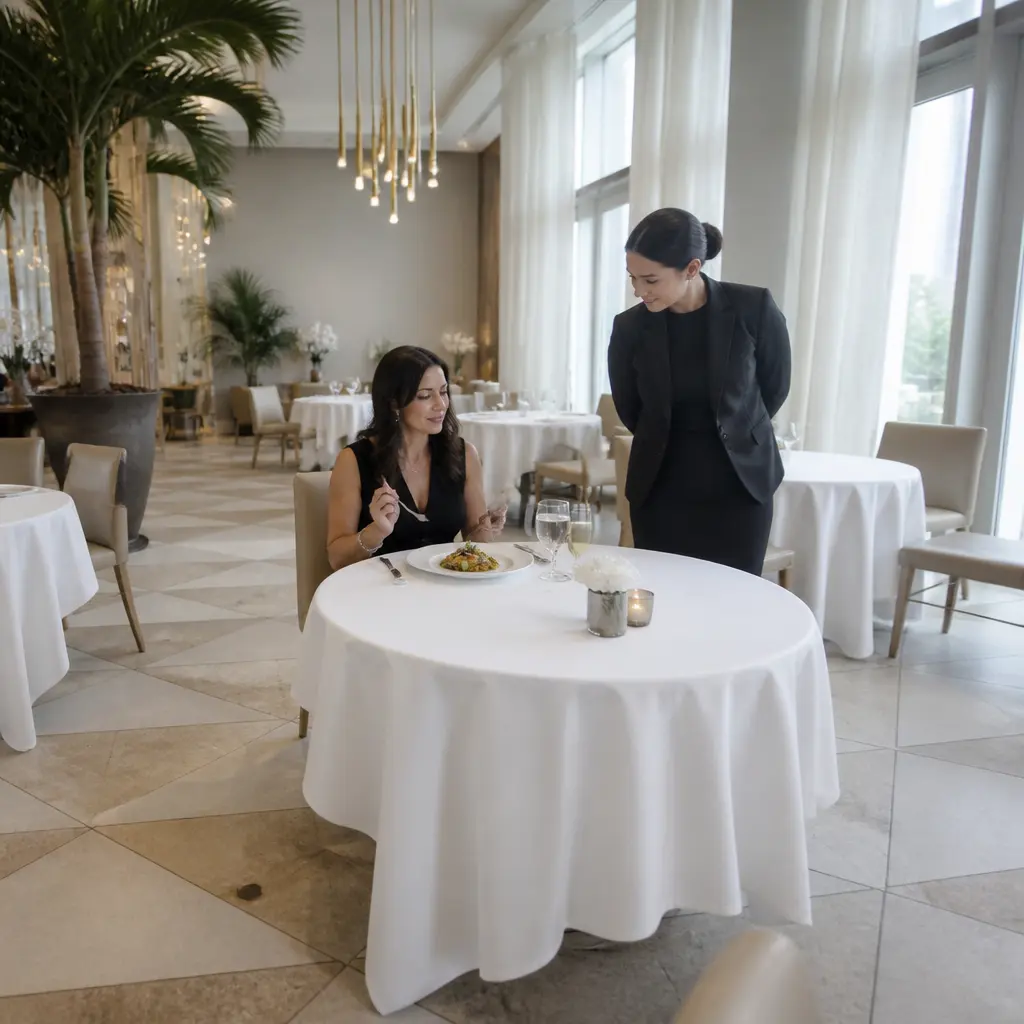
Fine dining is an intentional hospitality experience in which culinary skill, service, atmosphere, and consistency work together rather than merely an expensive meal. The clearest signs are disciplined cooking, thoughtful hospitality, transparent value, a coherent setting, and reliable execution across the entire visit. This distinction matters in a restaurant economy where U.S. consumers spent an average of $3,933 on food away from home in 2023, according to the U.S. Bureau of Labor Statistics, while the National Restaurant Association projected the overall restaurant industry would exceed $1 trillion in sales in 2024. A high price can indicate costly ingredients or labor, but it does not by itself prove refinement.
Fine Dining Demonstrates Intentional Hospitality
Fine dining can be defined as a restaurant experience built around elevated food, professional service, carefully managed surroundings, and a deliberate sense of occasion. The Michelin Guide evaluates restaurants through five universal criteria: quality of ingredients, mastery of cooking and flavor, the personality of the chef expressed through the cuisine, value for money, and consistency. That framework is useful because it separates observable performance from decorative luxury.
The category includes several hyponyms rather than one fixed format: tasting-menu restaurants, classic white-tablecloth dining rooms, chef’s-counter experiences, destination restaurants, contemporary bistros, and highly formal hotel restaurants. Some are quiet and traditional; others are theatrical or minimalist. Their common attribute is intentionality: each part of the experience has a purpose and supports the restaurant’s promise.
A Coherent Culinary Point of View
A culinary point of view is the recognizable logic behind a menu. It may express a region, season, technique, ingredient philosophy, cultural tradition, or chef’s personal interpretation. Expensive food can consist of luxurious ingredients assembled without a clear idea; fine dining generally makes the ingredients and techniques feel connected.
Evidence of a point of view includes a focused menu, purposeful substitutions, balanced progression in a tasting menu, and descriptions that explain rather than exaggerate. A restaurant does not need rare caviar, wagyu, or truffles to demonstrate sophistication. Precise treatment of beans, vegetables, grains, fish, or inexpensive cuts can show more skill than simply adding costly products.
This is where menu design becomes a practical test. A short à la carte menu may signal operational focus, while a tasting menu may reveal the chef’s intended sequence of textures, temperatures, and flavors. Neither format is automatically superior. The relevant question is whether the structure improves the meal or merely raises the bill.
Technical Precision on the Plate
Technical precision means that cooking, seasoning, temperature, texture, and portioning are controlled consistently. It does not require every dish to be complicated. A perfectly cooked piece of fish, a sauce with balanced acidity, or a vegetable prepared to retain its character may demonstrate more competence than a plate crowded with decorative elements.
Useful signals include food arriving at the intended temperature, crisp elements remaining crisp, sauces having appropriate concentration, and garnishes contributing flavor rather than visual clutter. Michelin’s emphasis on mastery of flavor and cooking supports this distinction: complexity is optional, but control is fundamental.
Fine Dining Converts Service Into Hospitality
Service is the organized human interaction that guides a guest through the meal while preserving comfort, dignity, and choice. Formal gestures such as synchronized plate service, tableside carving, or an extensive wine presentation can be impressive, but they are not the definition of hospitality. True service notices what the guest needs without making the guest feel managed.
Knowledge Without Performance
Knowledgeable service means staff can explain ingredients, preparation, allergens, portion sizes, substitutions, pacing, and beverage pairings accurately. The explanation should be proportionate to the guest’s interest. A server who can answer a technical question clearly is demonstrating expertise; a server who recites scripted language without listening is demonstrating theater.
Forbes Travel Guide’s hospitality standards place substantial emphasis on personalization, product knowledge, timing, and the ability to anticipate needs. In practical terms, that means recognizing dietary restrictions before they become problems, explaining an unfamiliar course, correcting an error without argument, and adjusting the pace when a table is celebrating or running late.
Pacing, Discretion, and Recovery
Pacing is the coordination of seating, ordering, courses, clearing, beverage service, and payment. A long meal is not automatically a refined meal. Delays without explanation, rushed courses, or plates arriving before the table is ready reveal weak coordination.
Discretion is equally important. Strong service avoids interrupting conversations repeatedly, does not pressure guests into upgrades, and handles mistakes privately. When something goes wrong, service recovery should be prompt and proportionate: acknowledge the issue, offer a practical remedy, and follow through. The ability to recover gracefully is often a better indicator of professionalism than a flawless scripted greeting.
Fine Dining Makes the Setting Support the Meal
Atmosphere is the combined effect of space, acoustics, lighting, table setting, temperature, music, cleanliness, and visual design. A costly dining room may contain expensive furniture yet feel uncomfortable, noisy, or self-conscious. Fine dining does not require chandeliers or white linens; it requires an environment that supports the restaurant’s concept and allows guests to enjoy the food.
Comfort and Functional Detail
Functional details are often more revealing than decoration. Tables should provide enough space, chairs should support a long meal, glassware should be clean, lighting should permit guests to see their food, and music should not overpower conversation. Restrooms, coat handling, reservations, accessibility, and temperature control also form part of the experience.
A useful diagnostic is to ask whether the room reduces friction. If guests struggle to hear, sit comfortably, understand the menu, or reach their belongings, luxury materials cannot compensate. Conversely, a modest room can feel genuinely special when its acoustics, lighting, layout, and service are carefully considered.
Consistency Across Touchpoints
Consistency is the ability to deliver the promised standard repeatedly, across dishes, shifts, and visits. Michelin lists consistency as one of its core criteria, and the principle applies beyond cooking: reservations should be handled reliably, the welcome should match the restaurant’s tone, and service should remain professional from arrival through departure.
This is also why one spectacular course does not automatically make a restaurant fine dining. A memorable dish surrounded by indifferent service, unexplained fees, or uneven pacing may be an isolated success. Fine dining is a system, not a highlight reel.
Fine Dining Aligns Price With Transparent Value
Value in fine dining is not the same as low cost. It is the relationship between what guests receive and what they are asked to pay, including food, labor, service, setting, expertise, and time. Michelin explicitly includes value for money in its evaluation criteria, demonstrating that luxury pricing is not exempt from scrutiny.
A Bill That Can Be Understood
Transparent value begins with a clear menu. Restaurants should identify whether courses are optional or mandatory, disclose supplements, explain beverage-pairing prices, and state taxes, service charges, or gratuity policies before payment. A high bill is easier to accept when the restaurant has communicated its structure honestly.
Unexpected charges are not proof that a restaurant is sophisticated. They are evidence of poor communication unless the policy was clearly presented in advance. The same applies to aggressive upselling of wine, water, premium ingredients, or additional courses.
Luxury With Restraint
Restraint is the discipline to stop when an experience is complete. It appears in balanced portions, purposeful garnishes, measured tableside presentation, and a wine list that offers guidance rather than intimidation. Restaurants may be lavish, playful, rustic, or highly modern, but the design should serve the guest rather than constantly advertise its cost.
A simple evaluation chart would score five dimensions—culinary point of view, technical precision, hospitality, environment, and price transparency—from one to five. A restaurant that scores highly only on ingredients or décor is likely expensive food. One that performs strongly across all five dimensions is much closer to true fine dining.
Fine Dining Is Proven by the Whole Experience
The difference between true fine dining and merely expensive food is not the presence of luxury ingredients, formal uniforms, or a large bill. Fine dining combines a coherent culinary point of view, technical control, informed and considerate service, a functional atmosphere, consistency, and transparent value. These attributes apply equally to a tasting-menu destination, a neighborhood chef’s counter, or a classic dining room.
For diners, the practical response is to examine the complete experience: read the menu and policies before booking, assess whether the restaurant’s concept is clear, notice how staff handle questions, and judge whether the price feels connected to quality and care. For restaurant operators, the broader lesson is that refinement is operational. Training, sourcing, pacing, maintenance, communication, and recovery all matter as much as presentation. Further reading from the Michelin Guide, Forbes Travel Guide, the National Restaurant Association, and the U.S. Bureau of Labor Statistics can help place individual dining experiences in a wider industry context.
Sources: Michelin Guide, The Inspector’s Five Universal Criteria, https://guide.michelin.com/us/en/article/features/the-inspector-s-5-universal-criteria; Forbes Travel Guide, What Is Forbes Travel Guide?, https://www.forbestravelguide.com/what-is-forbes-travel-guide; National Restaurant Association, 2024 State of the Restaurant Industry Report, https://restaurant.org/research-and-media/research/research-reports/state-of-the-restaurant-industry/; U.S. Bureau of Labor Statistics, Consumer Expenditure Surveys, https://www.bls.gov/cex/