
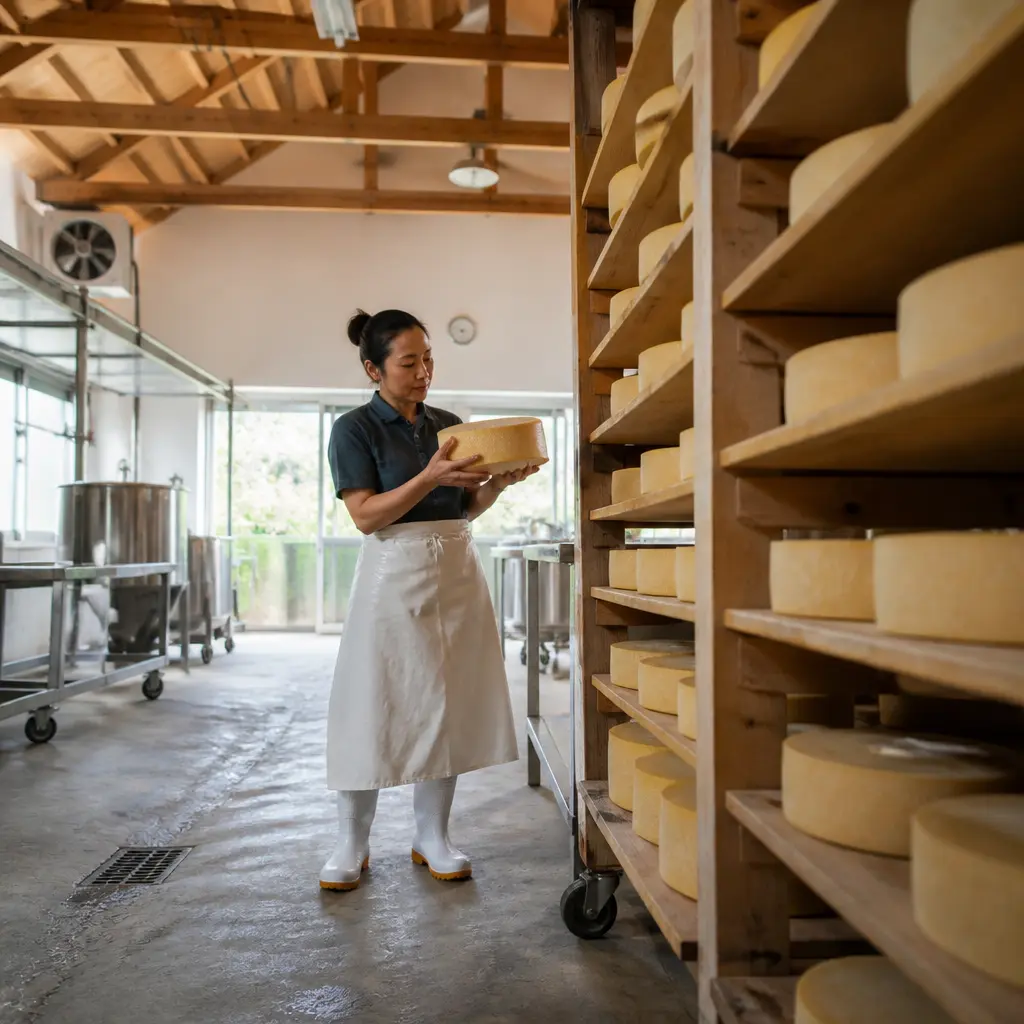
Taste—Human Hands is the idea that flavor is not only a chemical sensation or a product specification but also the result of people selecting, cultivating, preparing, timing, touching, and caring for food. Encounters with a baker shaping dough, a cheesemaker reading a curd, a chef adjusting heat by sight, or a farmer explaining a harvest make this visible: taste carries technique, judgment, place, and memory. The relevance is both cultural and economic. The European Commission records more than 3,500 protected geographical-indication names for foods and agricultural products, while the United Nations Environment Programme estimated that 1.05 billion tonnes of food were wasted at retail, food-service, and household levels in 2022. In a food system increasingly organized around scale and standardization, attention to human hands helps explain why freshness, craft, provenance, and hospitality remain powerful sources of value.
Human-Made Taste as a Sensory and Cultural Attribute
Human-made taste can be defined as flavor shaped by embodied human decisions across the life of a food, from choosing ingredients to serving the finished dish. Food historian and author Michael Pollan has described cooking as a form of cultural knowledge in which people transform raw materials through learned practices. The pairing is therefore not a claim that machines cannot produce good flavor; it is a way of identifying the human judgment that gives flavor its context and meaning.
Craft Taste: Skill Made Perceptible
Craft taste is the sensory result of practiced technique. A hand-shaped loaf may have irregular scoring, a wood-fired pizza may carry variations in blistering, and a hand-pulled noodle may differ subtly in thickness. These variations are not automatically signs of quality, but they can reveal decisions that a skilled maker made in response to humidity, temperature, fermentation, or the condition of an ingredient.
The Slow Food movement describes traditional food knowledge as a form of cultural heritage rather than merely a production method. Its approach connects flavor with biodiversity, local economies, and the people who maintain food traditions. This is especially important for fermented foods, in which timing and observation often matter more than a fixed recipe. Sourdough starters, cheese cultures, soy fermentation, and cacao fermentation all depend on human monitoring even when laboratories and sensors are also involved.
Provenance Taste: Place, People, and Process
Provenance taste is the way a food’s origin and production history become part of its perceived flavor. The European Union’s protected designation systems formalize this relationship by linking named foods to geographical areas, specified ingredients, and recognized methods. Parmigiano Reggiano, Roquefort, and Prosciutto di Parma illustrate how climate, local materials, maturation practices, and producer knowledge can become inseparable from a product’s identity.
A geographic label does not guarantee that every person will prefer the taste, but it gives consumers a framework for understanding why the taste is distinctive. It also makes labor more legible. When a customer learns that a cheese must be inspected during months or years of aging, a salty, nutty, or earthy note is no longer an isolated sensation; it becomes evidence of time, care, and risk.
Handwork Reveals Taste as Time and Judgment
The next connection is between human hands and time. Many memorable food encounters occur when a maker demonstrates that taste depends on waiting, adjusting, and responding rather than simply following a preset sequence. Handwork makes these invisible intervals visible.
Fermentation Taste: Living Processes Managed by People
Fermentation taste is flavor produced when microorganisms transform sugars, proteins, and other compounds under controlled conditions. Human beings do not dictate every microbial reaction, but they select cultures, manage temperature, regulate salt, judge readiness, and decide when to stop the process. The result may be acidity in sourdough, umami in miso, aromatic complexity in wine, or lactic sharpness in vegetables.
The Food and Agriculture Organization has long recognized fermentation as an important method for preserving food and improving its sensory qualities. Encounters with a baker or fermenter show that this knowledge is partly tactile and visual: a dough feels elastic, a starter smells ripe, and a cheese surface signals whether the aging environment is working. Such judgments are difficult to capture fully in a standardized instruction sheet.
Seasonal Taste: Freshness Interpreted Through Attention
Seasonal taste is flavor understood in relation to harvest timing and environmental conditions. A cook who tastes a tomato before deciding whether to grill it, salt it, or serve it raw is using human judgment to translate agricultural variation into a meal. The same variety can taste different according to rainfall, soil, storage, and the number of days since harvest.
This matters in a food economy where long-distance distribution often favors durability and uniform appearance. The United Nations Environment Programme’s estimate of 1.05 billion tonnes of food waste in 2022 demonstrates the scale of the mismatch between food production and food use. Human attention cannot solve waste alone, but closer relationships among growers, cooks, and eaters can encourage more flexible standards, fuller use of ingredients, and appreciation for foods that are imperfect in appearance but rich in flavor.
Service Taste: Hospitality as a Flavor-Making Act
Service taste is the part of an eating experience created through human interaction around food. Temperature, pacing, explanation, tableware, and the way a dish is handed to a guest can alter how it is perceived. A bowl of broth offered with an account of its ingredients can feel different from the same broth presented without context—not because the liquid’s chemistry has changed, but because attention changes perception and memory.
UNESCO’s recognition of the gastronomic meal of the French and traditional Mexican cuisine as intangible cultural heritage supports this broader understanding. These traditions are not limited to recipes. They include preparation, serving, social roles, celebration, and the transmission of knowledge. Taste becomes a shared event in which the hands of cooks, servers, hosts, and guests all participate.
Human Hands Distinguish Craft from Mere Authenticity
Human-made taste should not be confused with a simple promise of authenticity. “Handmade” can be used as a marketing label, and manual production is not always safer, more sustainable, or more delicious than mechanized production. The meaningful question is which human decisions affect the food and whether those decisions are visible, fairly compensated, and supported by evidence.
Evidence of Skill Rather Than Romantic Storytelling
Evidence of skill includes transparent production methods, identifiable producers, consistent standards, and an explanation of how technique affects flavor. A restaurant may describe the farmer who grew its beans, the miller who produced its flour, or the cheesemaker who aged its wheels. These details become credible when they can be connected to observable practices rather than vague language about tradition.
The Specialty Coffee Association’s sensory framework demonstrates how trained tasters describe flavor through aroma, acidity, body, sweetness, and aftertaste. This kind of vocabulary does not remove the human element; it makes judgment more communicable. A barista who adjusts grind size and extraction time is combining measurement with sensory interpretation, showing that craft can be both disciplined and personal.
Labor Visibility and the Price of Taste
Labor visibility means recognizing the people whose work makes flavor possible. Farmers, harvesters, fishers, millers, drivers, dishwashers, cooks, and servers all contribute to the final encounter. When a product is praised as “artisanal” while its workers remain invisible or underpaid, the language of human hands becomes decorative rather than ethical.
The United States Bureau of Labor Statistics regularly reports that food preparation and serving occupations employ millions of people, illustrating how much of the eating experience depends on human work even in highly automated supply chains. Paying attention to hands should therefore lead to questions about wages, safety, training, working hours, and access—not only admiration for the finished flavor.
Encounters That Make Human-Made Taste Memorable
The strongest encounters often involve a small act of explanation or participation. A cheesemaker cuts open a wheel to show its texture; a baker lets a customer smell a starter; a chef serves a trimmings-based dish and explains why nothing was discarded; or a farmer offers two varieties of the same fruit side by side. These moments turn taste into a conversation between knowledge and sensation.
The Demonstration: Watching Judgment in Real Time
A demonstration validates craft because it reveals decisions as they happen. Watching a cook alter seasoning after tasting, or seeing a potter-like motion in the shaping of pasta, helps an observer understand that recipes are frameworks rather than guarantees. The encounter also teaches consumers to notice texture, aroma, temperature, and finish.
The Shared Table: Taste as Social Memory
A shared table connects individual taste with collective memory. Family recipes, religious feasts, neighborhood bakeries, and market stalls preserve techniques by repeating them in social settings. The meal becomes a record of migration, adaptation, celebration, and loss. This is why a familiar flavor can remain meaningful even when the ingredients or surroundings have changed.
The Repair of Attention
Human-hand encounters repair attention by slowing down consumption. They encourage people to ask who made a food, how long it took, what was changed along the way, and what conditions made the flavor possible. This does not require every meal to be expensive or laborious. It can begin with buying directly from a producer, learning one preservation method, cooking an overlooked ingredient, or thanking the workers who prepare a meal.
Conclusion: Taste Remains a Record of Human Hands
Human-made taste joins craft, provenance, time, service, and labor into one attribute of eating. Craft taste makes skill perceptible; provenance taste connects flavor with place; fermentation taste shows people managing living processes; seasonal taste links freshness with attention; and service taste reveals hospitality as part of perception. The more standardized food becomes, the more valuable these encounters can be—not as a rejection of technology, but as a reminder that tools still depend on human purposes and judgments.
Readers can explore this idea by visiting a farmers market, speaking with a producer, learning to taste comparatively, documenting a family food tradition, or choosing products whose labor and origin are transparent. Further reading in food history, sensory science, labor studies, and agricultural policy can deepen the lesson: taste is never only on the tongue. It is also in the hands that grow, transform, serve, and share what we eat.
Sources: European Commission, Geographical Indications and Quality Schemes, https://agriculture.ec.europa.eu/farming/geographical-indications-and-quality-schemes_en; United Nations Environment Programme, Food Waste Index Report 2024, https://www.unep.org/resources/report/food-waste-index-report-2024; Food and Agriculture Organization of the United Nations, Fermented Foods, https://www.fao.org/3/y1579e/y1579e00.htm; UNESCO, The Gastronomic Meal of the French, https://ich.unesco.org/en/RL/the-gastronomic-meal-of-the-french-00437; UNESCO, Traditional Mexican Cuisine, https://ich.unesco.org/en/RL/traditional-mexican-cuisine-ancestral-ongoing-community-culture-the-michoacan-paradigm-00400; Specialty Coffee Association, Coffee Taster’s Flavor Wheel, https://sca.coffee/research/coffee-tasters-flavor-wheel; United States Bureau of Labor Statistics, Occupational Outlook Handbook: Food and Beverage Serving and Related Workers, https://www.bls.gov/ooh/food-preparation-and-serving/food-and-beverage-serving-and-related-workers.htm; Slow Food, About Slow Food, https://www.slowfood.com/about-us/